

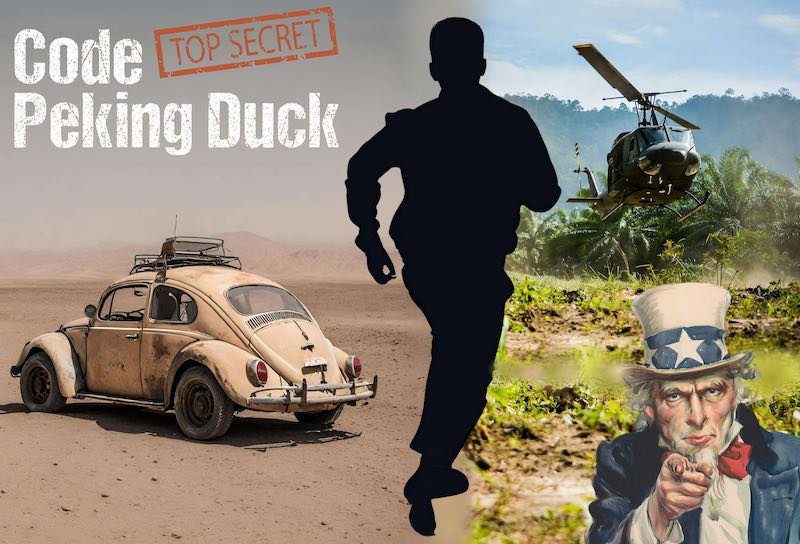
Mr Claro, your book “Code Peking Duck” tells the story of a young German who drops out of high school in the 1970s and heads to the US, but things don’t go his way so he joins the U.S. Army – although he identifies himself more with the hippie movement, but subsequently is sent to Vietnam, where he deserts and ends up working as a secret agent for the CIA and the BND. If you summarize it like that, it sounds quite exaggerated. But you tell it so realistically that while reading it, we get the feeling that you yourself could be this, Michael Müller. Is that so?
This book is a novel. But you’re right: It contains a lot of autobiographical elements. I experienced most of it myself. Many of the people involved really existed or still do exist.
In the US, the protagonist discovers that it is not that easy to make a living without a job. He gets to know pimps and heroin-addicted prostitutes, he becomes an assistant to a sand painting artist in Los Angeles, works as a seafood process worker in San Diego and finally ends up in the army. Why did you join the army when you were more interested in peace?
The Flower Power “Make Love Not War” in Southern California went on for weeks, where I spent some of the best times in my life. Nevertheless, in contrast to my hippie friends, it was always clear to me that this could only be a temporary phase. After all, I had come to America to go from rags to riches, but not live in a dream world. Unfortunately, the Army recruiters in their neat uniforms were the only ones who offered me regular meals and a real opportunity in my life. Of course, I was afraid of being used as cannon fodder in Vietnam and – at least as bad – of having to shoot other people. But the Pentagon Papers boosted the anti-war movement which had just been published, and so I believed in my recruiters‘ prediction that the Vietnam War would be long over by the time I finished my training. A miscalculation …
And how did it happen that you suddenly found yourself in Da Nang, Vietnam, in December 1971?
I was supposed to complete the final part of my practical training as a combat medic in a field hospital in Da Nang. The transfer was sudden and unexpected.
At first, you didn’t think it was that bad in Vietnam, right?
That’s not true. I never wanted to go to Vietnam and actually believed the war would be over once I finished my training. I knew that I could be killed or forced to kill others at any moment. When I set foot on the Vietnamese soil my immediate thought was to desert at the first possible opportunity. My second thought was to make most of the time in Vietnam. I tried to gain substantive amount of medical knowledge at the field hospital and at the same time to cheer up the severely tormented and traumatized patients.
How you deserted is so unbelievable and fascinating that you couldn’t possibly have made it up. Of course, a healthy dose of audacity and a knack for lying came in handy. Did you know beforehand that you could pretend and lie so well?
No. But necessity is the mother of invention. After all, it was a matter of life and death.
You were incredibly lucky because instead of ending up in prison as a deserter, you were recruited as a secret agent. You must explain that.
I never saw that as luck. I never wanted to be an agent. It was simply about picking my poison. Once CIA agents got their heads around the extraordinary nature of my desertion, they were so impressed that they wanted to recruit me and offered to close my infamous army file in exchange for my cooperation.
As a secret agent, one of the problems you faced was that your girlfriend became suspicious when you suddenly disappeared for a lengthy period of time and couldn’t provide a reasonable explanation. Did you still like your agent job?
As a rule: no life partner is satisfied with the information that you need to travel for a while on a top-secret mission. They demanded more detail, ideally with evidence, but that would be fatal which would put both partner and mission at great risk. You then must choose either the job or the relationship. This can be very painful, and yes, over time I grew to like the missions, the adventure, the opportunity to travel around the world at US government support, you get to know new cultures, help people with immense difficulties and at the same time make good money.
What were the tasks you had to do for the CIA?
My tasks – at least towards the end of 1979 – consisted exclusively of bringing certain escort targets from the Eastern Bloc countries and the Middle East to the West.
Are you even allowed to talk about it so openly?
The duration of my confidentiality was never specific. The world has changed drastically in the last four decades since my last described deployment. I assume that my revelations won’t stir things up or endanger anyone.
You made a lot of money as an agent. But one day you didn’t want to do this anymore. What was it like to suddenly no longer earn such large sums of money?
A comparison with the job of acting comes to mind: Do actors really earn a lot if they get paid 50 grand for a role and then are unemployed for the rest of the year? There were also jobs with much lower or no pay and a few really big ones. An employee on a regular average income does not earn less than that over the years. Between my agent jobs, sometimes simultaneously, I worked in normal, regular jobs as a nurse or paramedic. However, these jobs were, and still are, utterly underpaid. That’s why any financial boost was welcome to me. It was only the Bushehr contract, which gained me a royal payment. This allowed me to set up my own company and become independent.
Why did you quit as an agent?
At some point I started a family. However, having a family and being an agent does not go hand in hand. With a family whilst going on missions, you give opportunity to be blackmailed, besides that, you carry responsibility as a partner and father, you can’t just die or vanish for a few decades in a foreign prison.


Für den Chat bitte einloggen